You face a fast-changing threat landscape where attackers and defenders both use AI. That’s why understanding Cyber Security VS AI matters now more than ever. In 2026, the strongest posture blends smart controls, trustworthy data, and AI-driven speed.
This guide shows you how to align your policies, people, and platforms with AI-enabled defenses. You will learn where AI helps, where it hurts, and what to do next.
“AI will not replace your security team, but teams using AI will outpace those that don’t.”
Key Takeaways
- AI scales defense: Use it to detect anomalies, triage alerts, and automate containment.
- Humans set the guardrails: Define risk appetite, policies, and review AI decisions for bias and errors.
- Data quality rules: Clean, labeled, and governed data makes AI reliable and auditable.
- Zero Trust stays essential: Assume breach, verify explicitly, and minimize permissions.
- Regulatory fit: Map controls to U.S. frameworks like NIST CSF 2.0 and CISA guidance.
- Measure outcomes: Track dwell time, mean time to detect (MTTD), and mean time to respond (MTTR).
Understanding cybersecurity and AI in 2026: Risks, Rewards, and Realities
Why AI Changes Both Attack and Defense
Attackers use generative tools to craft spear-phishing, mutate malware, and scan for exposed secrets. Defenders, however, can analyze billions of events per day and flag outliers in minutes. Because speed wins, you should target faster detection and response over pure prevention.
Use AI to enrich alerts with context, but keep human approval for actions that can disrupt business. For example, auto-isolate a suspected endpoint, then require an analyst to release it.
Top Risks: Model Blind Spots, Data Leaks, and Automation Overreach
AI can hallucinate, miss novel threats, or misclassify benign behavior. You also risk leaking sensitive data into third-party models. Therefore, restrict training inputs, apply data loss prevention, and red-team your models with adversarial tests.
Set kill-switches and rate limits on automated playbooks. When your AI is unsure, it should escalate to a human, not guess. That balance reduces false positives that drain your team.
U.S. Standards and What “Good” Looks Like in 2026
Assume a U.S.-led audience operating globally. Anchor your program to recognized frameworks, while noting local obligations such as Singapore’s PDPA for regional operations.
The updated NIST Cybersecurity Framework and CISA alerts help you prioritize controls that attackers actually test. Also, train staff with real phishing simulations and incident drills.
Map each AI control to a policy and evidence trail. Auditors will ask how your AI makes decisions, how you monitor drift, and how you roll back bad models.
| Capability | Traditional Security | AI-Augmented Security (2026) |
|---|---|---|
| Threat Detection | Signature and rule-based | Behavioral analytics and anomaly scoring |
| Alert Triage | Manual queue processing | Automated enrichment and risk ranking |
| Incident Response | Runbooks executed by humans | SOAR playbooks with human-in-the-loop approvals |
| Policy Enforcement | Periodic audits | Continuous, context-aware verification (Zero Trust) |
| Attack Adaptation | Slow rule updates | Online learning and rapid model retraining |
If you operate APIs or data-heavy systems, a secure-by-design architecture pays off. For a practical primer, see Performance-optimized, Secure Architectures on nicktung.com.
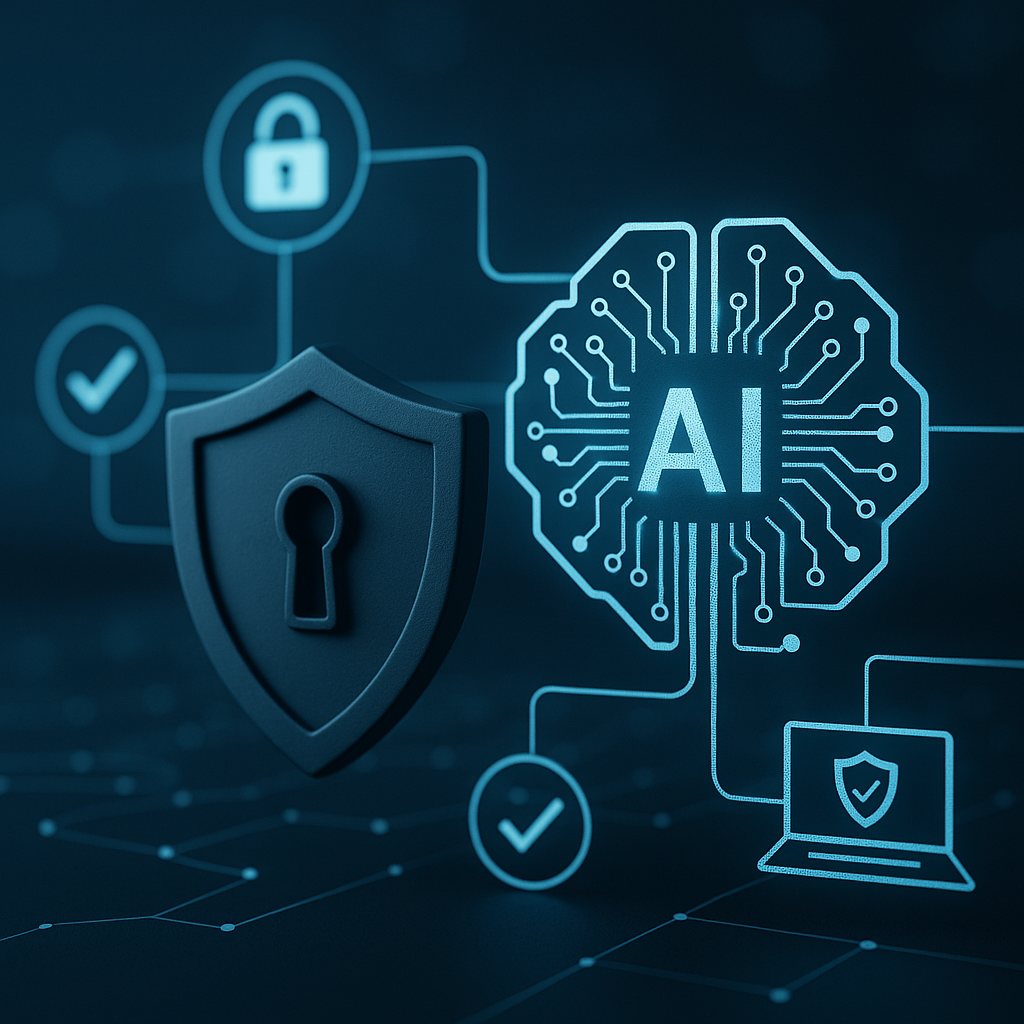
AI-Powered Defense: Automating Prevention, Detection, and Response
Hardening Identity, Endpoints, and Networks with AI
Start with identity. Enforce phishing-resistant MFA, continuous authentication, and just-in-time access. Then, use AI to score session risk and step up verification when behavior changes. Because most breaches start with accounts, this step delivers outsized returns.
On endpoints, deploy EDR with AI detection and rollback. On networks, enable DNS filtering and anomaly-based IDS to catch command-and-control traffic.
From Alerts to Action: Building Smart SOAR Playbooks
Automate the boring, not the risky. For example, when a high-confidence malicious hash appears, quarantine the file, notify the user, and open a ticket. But require analyst approval to disable accounts or block domains at scale.
- Define triggers and confidence thresholds.
- Enrich with threat intel and asset context.
- Execute least-disruptive actions first.
- Escalate when confidence is low or blast radius is high.
Track MTTR and user impact for each playbook. Iterate monthly so your automation learns from incidents.
Data Governance, Model Oversight, and Compliance
Your AI is only as good as your data. Classify sensitive fields, mask PII in logs, and separate training, validation, and production datasets. Also, implement model versioning, feature stores, and drift detection to keep outputs stable.
Document decisions. Maintain a model card that explains inputs, limitations, and testing. For background on AI concepts, see Artificial Intelligence and the evolving U.S. policy landscape via the White House AI initiatives.
Finally, align contracts and vendor reviews with your security standards. Include right-to-audit, incident notification SLAs, and data residency terms to avoid surprises.
In practice, the smartest path is blending disciplined engineering with fast AI assistance. That is the real edge in the security–AI balance—you win when both work together.
Adversarial AI: How Attackers Exploit the Cyber Security VS AI Gap
Threat actors weaponize AI for phishing at scale, deepfake voice fraud, and automated vuln discovery. Defend by red-teaming models, adding adversarial training, enforcing human-in-the-loop for high-impact actions, and monitoring LLM prompt/response logs for abuse patterns. Align runtime controls with a hardened, zero-trust core.
Governance and Compliance in 2026: Policies, Privacy, and Responsible AI
Model governance ties directly to regulatory obligations. Once you define data flows and risks, translate them into policy controls and enforceable contracts.
Treat models as regulated systems: data minimization, PDPA-aware logging, retention limits, vendor SLAs, and documented model cards. Example: AI Rank, a Singapore-based digital solutions firm, pilots AI features with clear success criteria before scaling to production, reducing risk while proving value.
Watch on YouTube
Building a Resilient Roadmap: Talent, Tooling, and Trusted Partners
Upskill SecOps with ML basics, establish MLOps + DevSecOps handoffs, and standardize on telemetry, sandboxing, and auto-remediation runbooks. Prefer tools with strong auditability and drift alerts. Partner selectively; verify outcomes, not promises.
Watch on YouTube
Conclusion
Cyber Security vs AI isn’t a cage match—it’s orchestration. Pair disciplined engineering with focused AI to cut risk and MTTR while safeguarding privacy. Ready to translate strategy into secure, high-performance execution? Visit our guide on API security best practices for Singapore businesses.
FAQ
Q1: What’s the fastest win with AI in security?
A: Triage and alert deduplication to reduce noise—for example, SOAR enrichment combining threat feeds with your CMDB to auto-close benign duplicates.
Q2: How to avoid LLM hallucinations in SOC use?
A: Retrieval-augmented generation and confidence thresholds, plus human review on low-confidence answers.
Q3: Does AI replace pentesting?
A: No—use it to augment human-led testing, such as prioritizing likely exploitable findings.
Q4: How do we measure value?
A: MTTR, false-positive rate, containment time, and user impact. Set a baseline, such as “MTTD under 15 minutes for Sev-1,” then track monthly deltas.
Q5: What about data privacy?
A: Mask PII, limit retention, and audit model access regularly. Also, restrict training inputs to approved datasets.
Leave a Reply